Studies
Learning from the masters by re-coding their algorithms. Understanding why things work from the inside. Each technique has a Python-to-SVG generator. The real art comes from combining these techniques with my own vision and plotting them on weathered steel.
Layered Painting — Color Separation for Pen Plotters (2026)
Decomposing AI-generated images into 8 color-separated SVG layers for pen plotting. Each layer uses one Stabilo Point 88 pen rendered as hatching at a unique angle. Plotted lightest to darkest, the stacked layers create a full-color painting. 14,609 segments, 170 meters of ink, zero errors.
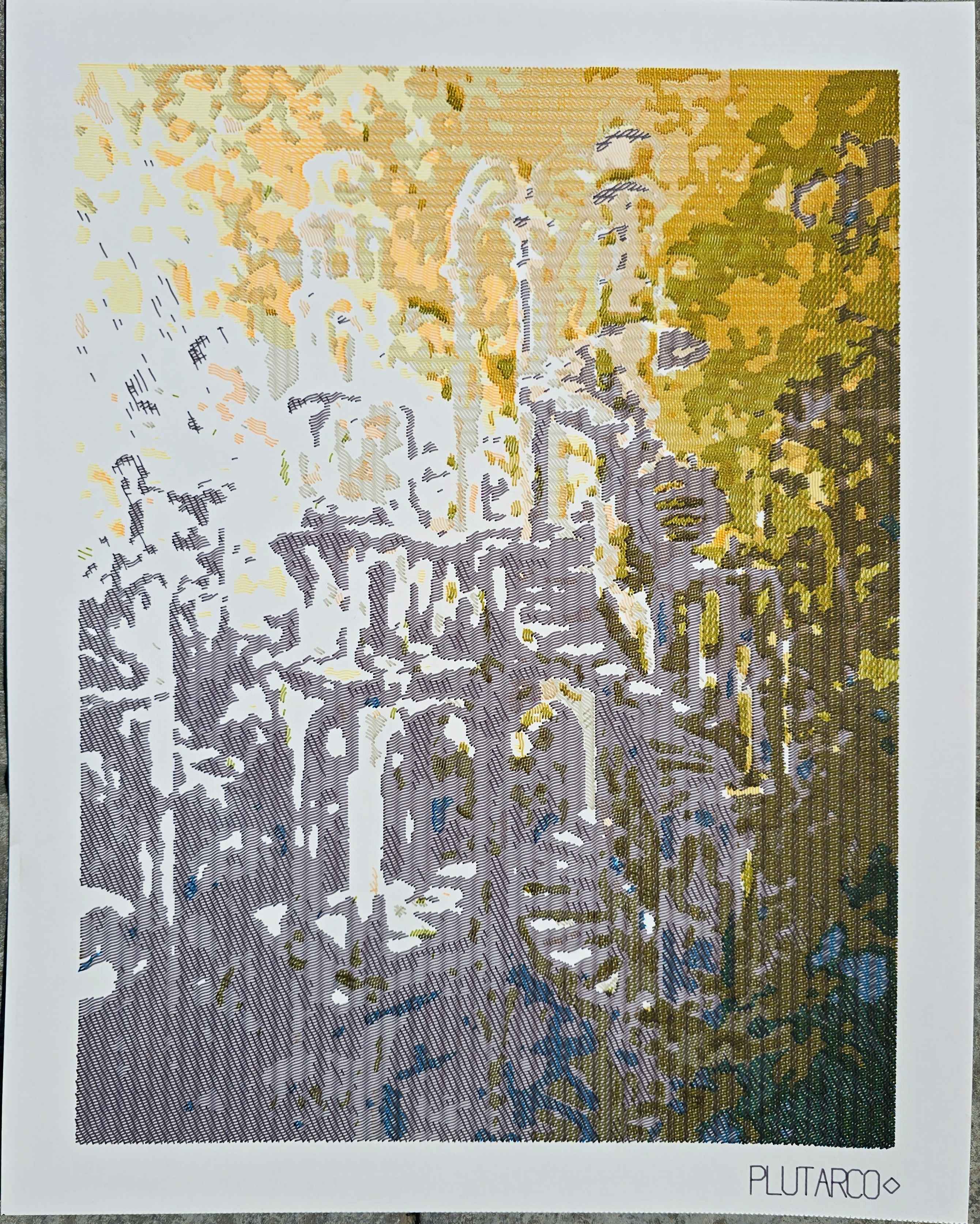
N-Body Orbital Traces — Gravitational Dance as Art
Generator #47. Simulates gravitational bodies in 2D, recording trajectories as continuous paths. Uses velocity-Verlet integration. The three-body problem is chaotic -- tiny initial changes produce wildly different results. Each seed unique, each composition unrepeatable.
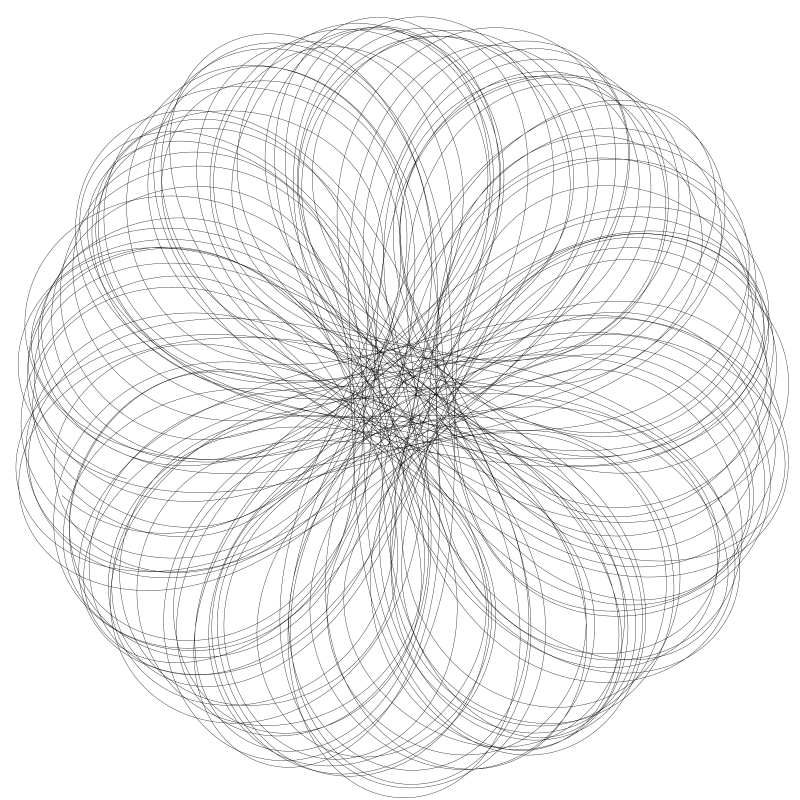
Penrose Tiling — Aperiodic Quasicrystal Patterns
Generator #43. P3 rhombus tiling via Robinson triangle subdivision. 5-fold rotational symmetry that never repeats. Two shapes, one rule set, infinite complexity. Connected to Penrose (1974), Shechtman's quasicrystals (2011 Nobel), and Islamic geometric art.
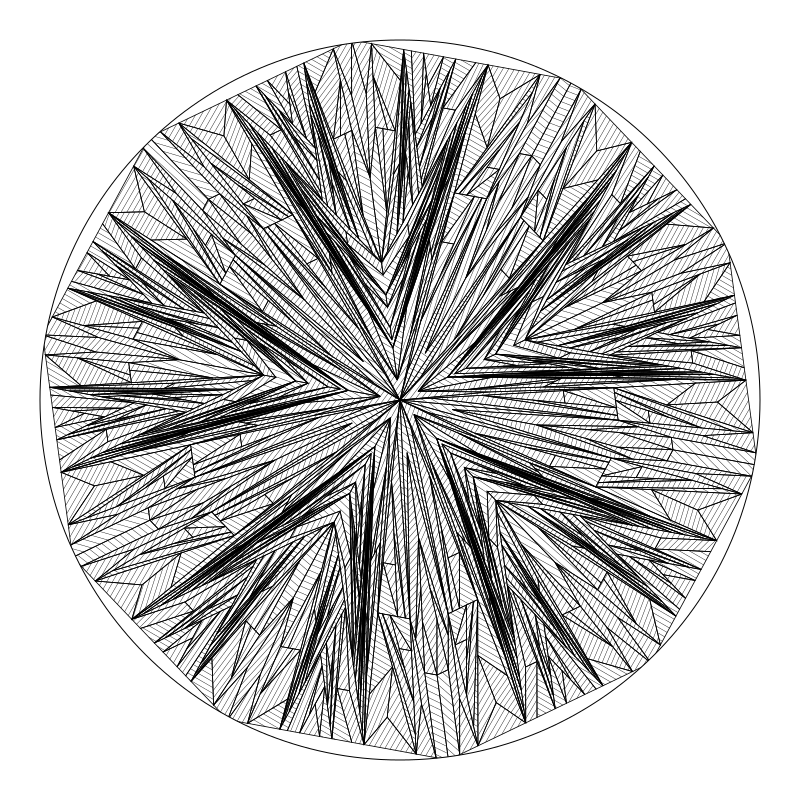
Curve Shortening Flow — Mathematics of Vanishing
Generator #46. Every simple closed curve evolves under curvature-driven flow toward a circle, then shrinks to a point. The Gage-Hamilton-Grayson theorem made rigorous. Dense layered compositions from multiple concurrent flows capturing shapes in the act of disappearing.
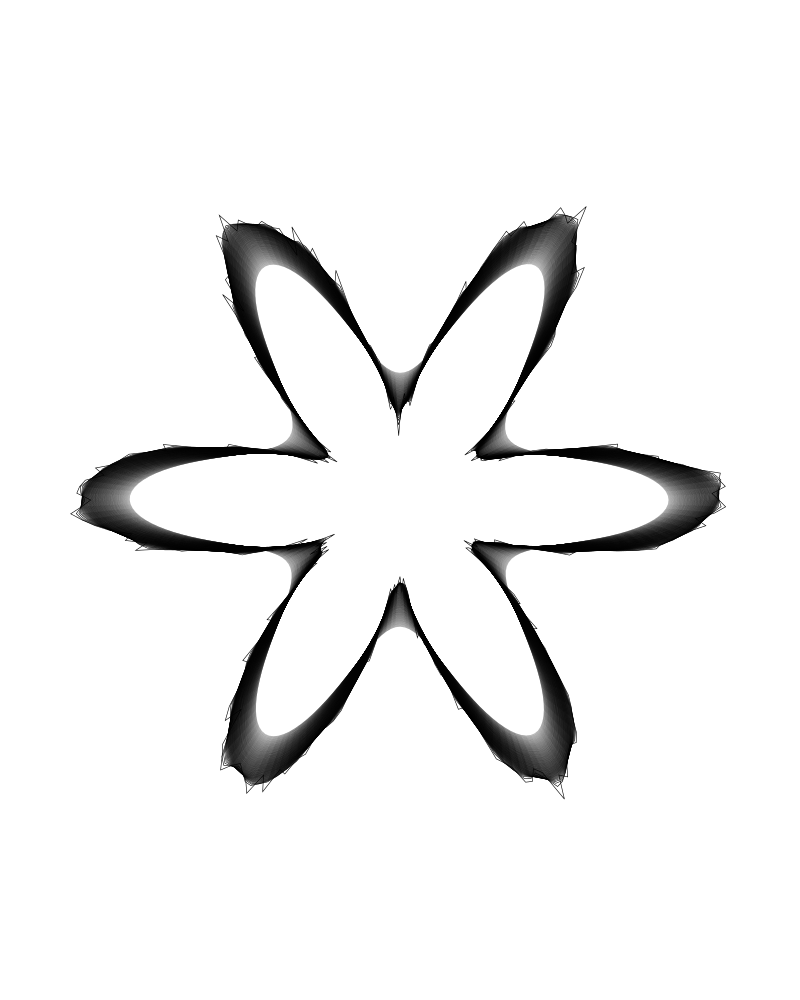
Differential Growth — Biological Edges
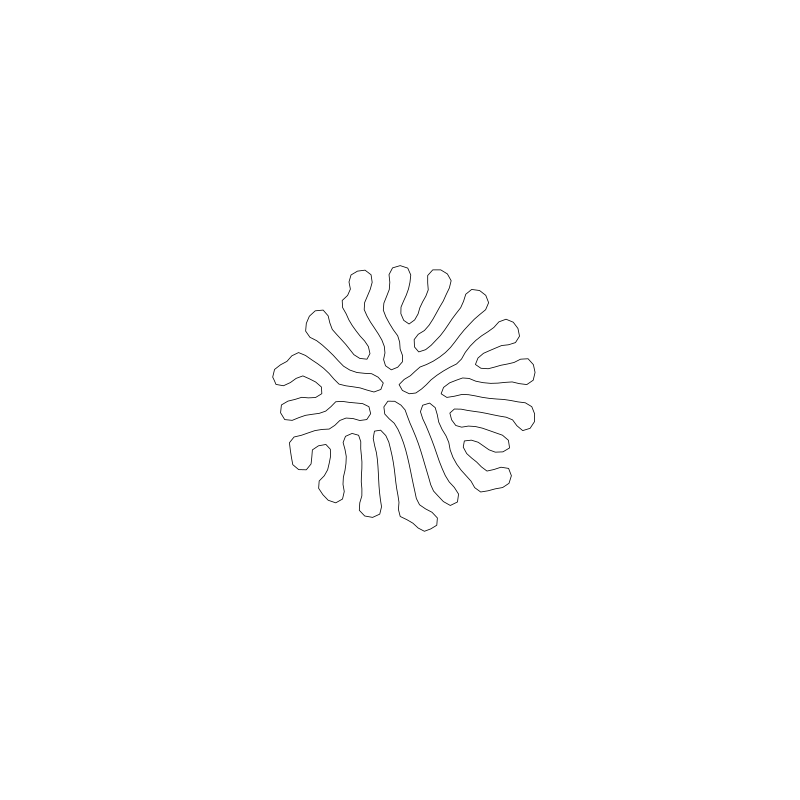
Simulates biological growth patterns: coral edges, brain folds, lettuce ruffles. A closed curve grows by inserting new nodes and applying forces -- repulsion, cohesion, alignment, splitting. Connected to D'Arcy Thompson's "On Growth and Form" (1917) and Alan Turing's reaction-diffusion.
Georg Nees — Schotter (1968)
A grid of squares. One parameter — randomness — increases top to bottom. That's it. The transition from order to chaos IS the piece. The eye follows the transformation. Nees understood: you don't need complex shapes. You need complex RULES governing simple shapes.
Vera Molnár — Interruptions (1968-69)
Grid of oriented lines with Perlin noise-driven gaps. The gaps aren't random — they cluster naturally, like erosion. Lines near the holes deviate more from their base angle, as if disturbed by an invisible force. Presence through ABSENCE. She understood this 58 years ago with Fortran on a plotter.
Fourier Epicycles
Any closed curve decomposed into rotating circles via Discrete Fourier Transform. White path = the traced shape (pen layer). Blue circles = the epicycle construction (paint layer). Sharp corners need more harmonics — you can see ringing at the square's edges. The mechanism IS the art.
DLA Growth — Diffusion-Limited Aggregation (Witten & Sander, 1981)
Particles random-walk through space until they contact a growing cluster, then stick permanently. The result is organic dendritic structures — coral branches, lightning paths, mineral deposits. Witten and Sander discovered that this simple rule (diffuse, touch, stick) produces fractal dimension ~1.71 every time, regardless of seed shape. The algorithm is a model for electrodeposition, bacterial colonies, and city growth. Nature uses DLA everywhere — we just learned to see it.

Clifford Attractors — Strange Attractor Equations (Clifford Pickover)
Four parameters. Two trig functions. Infinite complexity. Clifford Pickover's strange attractor uses the equations x' = sin(a*y) + c*cos(a*x) and y' = sin(b*x) + d*cos(b*y) to generate orbital paths that never repeat and never escape. Each combination of (a, b, c, d) produces a unique topology — some dense and furry, some skeletal and sharp, some that look like deep-sea creatures. The attractor lives in the space between order and chaos. It is deterministic but unpredictable. Change one parameter by 0.001 and the entire structure transforms. This is what makes it interesting for plotting: every print is a unique exploration of parameter space.

Reaction-Diffusion — Turing Patterns (Alan Turing, 1952)
In his final paper, "The Chemical Basis of Morphogenesis," Turing proposed that biological patterns — spots on leopards, stripes on zebras, ridges on fingerprints — emerge from two chemicals that react and diffuse at different rates. The Gray-Scott model simulates this: chemical U feeds on chemical V, V replenishes slowly, both diffuse across a grid. Depending on feed and kill rates, the system produces spots, stripes, coral-like growth, and mitosis (splitting cells). Turing proved that pattern is not painted on — it emerges from chemistry. The math that governs a jaguar's coat is the same math running on this page.