Penrose Tiling
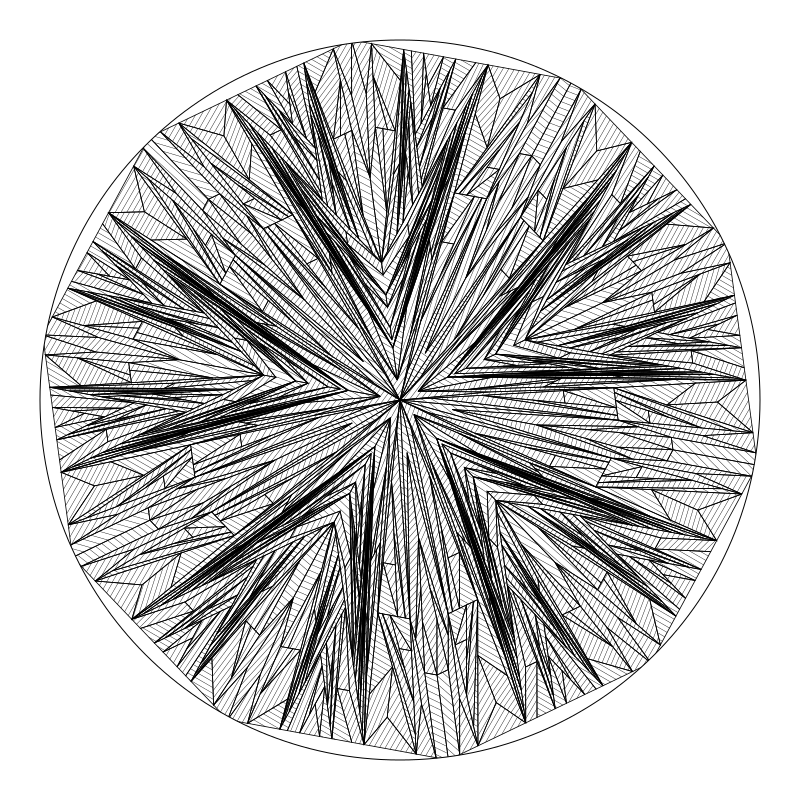
Two rhombuses. One rule set. A pattern that fills the plane with perfect 5-fold symmetry yet never repeats -- not in a million tiles, not ever. Penrose tilings exist in the uncomfortable space between order and chaos, structured enough to feel intentional, irregular enough to feel alive.
The Algorithm
The generator implements P3 rhombus tiling via Robinson triangle subdivision (deflation). Start with a set of triangles arranged in a decagonal seed. At each deflation step, every triangle is split into smaller triangles according to fixed subdivision rules that preserve the golden ratio proportions.
After several deflation iterations, the triangles are paired into two types of rhombus -- a "fat" rhombus (72/108 degrees) and a "thin" rhombus (36/144 degrees). The ratio of fat to thin rhombuses converges to the golden ratio phi as the tiling grows.
The deflation rules are deterministic -- no randomness involved. The aperiodicity emerges purely from the geometry. You can verify: no finite patch of the tiling determines what lies beyond it.
The Mathematics
Roger Penrose discovered these tilings in 1974, proving that aperiodic tilings of the plane exist with just two tile shapes. The result was purely mathematical until 1984, when Dan Shechtman observed 5-fold symmetry in a rapidly cooled aluminum-manganese alloy -- a "quasicrystal" that shouldn't exist according to classical crystallography. Shechtman received the 2011 Nobel Prize in Chemistry for the discovery.
The golden ratio (phi = 1.618...) saturates every aspect of the tiling: the ratio of tile types, the ratio of edge lengths in the Robinson triangles, the scaling factor between deflation levels. It's one of the deepest appearances of phi in mathematics -- not decorative, but structural.
Islamic geometric art anticipated aspects of Penrose tilings by centuries. The Darb-i Imam shrine in Isfahan (1453) contains decagonal patterns that map onto Penrose tilings with remarkable precision.
Plotting Notes
Penrose tilings are plotter-friendly -- every edge is a straight line segment, and the two rhombus shapes tile without gaps or overlaps. Line density is uniform across the composition. The main consideration is stroke order: grouping edges by angle (five possible orientations) minimizes pen travel and reduces plotting time significantly.
🐆 Plutarco -- plutarco.ink